Imagination Crystals | Orit Ben Shitrit
Curator: Michal Mor
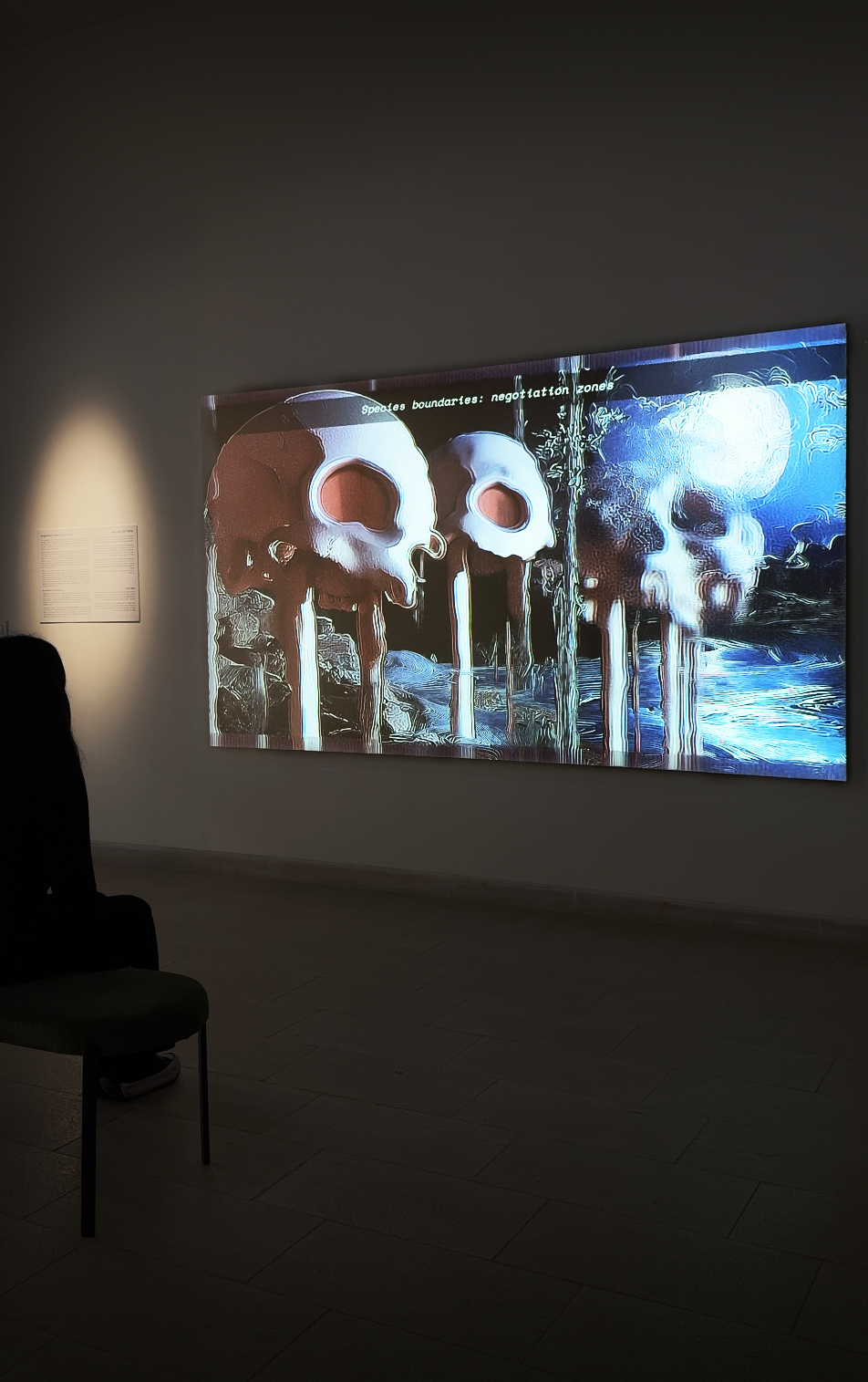
Can imagination create reality? Not as a poetic gesture, but as an empirical inquiry into the mechanics of perception and the degree to which the future takes shape in the space between expectation and action. At the heart of Orit Ben Shitrit’s new exhibition, Imagination Crystals, is an image-generating work that acts as both a record of possible futures and a sensory experiment — and one that only works if you take part.
The title points to the threshold moment before the image appears: the choices have been submitted, the screen is still blank, and in that one-second gap, the mind is already processing and forging connections. The crystals are the thought-dust generated in that suspended moment between question and answer. That gap is where the future takes form. The work draws on the Kuleshov Effect, a montage principle from early Soviet cinema showing that meaning doesn’t live in the filmed material itself, but is built in the viewer’s mind through the collision of fragments. Ben Shitrit extends this logic into an immersive encounter where the work offers only the raw components — image, sound, and language — from which each viewer constructs their own private future.
Philosophical Context: Imagination as a Generative Force
While many contemporary works dealing with Artificial Intelligence (such as those by Pierre Huyghe) focus on a post-human world, a cold, mechanical realm where the human is no longer central, Ben Shitrit takes the opposite trajectory. She redirects the gaze toward human imagination as a vital, generative force. Her question is not how AI might replace humanity, but rather what our own imagination is capable of when granted the freedom to act without a predetermined outcome.
The work posits that the act of imagining is, in fact, world-building. As the philosopher Ernst Bloch described it, this is a form of “anticipatory consciousness”: the ability to reach into the future and give preliminary shape to possibilities yet to occur. The seven lineages presented in the work are not closed classifications, but invitations to reflect on the blurring boundaries between body, technology, and nature.
The sound moves between deep somatic frequencies and bright, even playful rhythms. The choice of lightness and humor amidst a violent reality is not an escapist tactic, but a deliberate moral stance. Humor is a serious tool: it refuses to let the weight of the present become the only language available to us. The music succeeds in asking what the image cannot always capture: How does the desire for something that does not yet exist feel? And what happens when this desire suddenly meets you in the form of an unexpected melody?
The Mechanism: Algorithmic Reflection
Visitors are invited to respond to a sequence of questions concerning content, materiality, and time. This serves as a score (partitura) that directs attention without dictating a result. Each combination of answers generates three simultaneous outputs: a hybrid entity for the year 2126, a philosophical proposition, and a sound composition incorporating sub-sonic frequencies, vibrations perceived by the body before the ear can decode them.
The system is capable of producing nearly 280,000 unique combinations, accumulating into a collective memory. When the gallery is empty, the system enters a Ruminative State: previous inputs merge, forms from different days cross-pollinate, and the work continues to evolve without a guiding hand.
The gallery does not remain silent; it thinks.